
Why Understanding the Density of Glass Matters

The density of glass tells you about the mass of the material for a given volume. This value is a benchmark for calculating the weight of an object and understanding why its composition and dimensions matter.
What is the density of glass depending on its composition?
Distinguishing between density and the bulk density of glass
In everyday language, density and bulk density are often used as synonyms. Yet they refer to two different quantities.
Bulk density is the mass of a material divided by the volume it occupies. It is expressed in kilograms per cubic metre or in grams per cubic centimetre, among other units. Density (relative density), for a solid, compares this bulk density to that of water used as a reference. It has no unit.
For soda-lime glass, the following approximate equivalences apply:
- Density: 2.5, unitless.
- Bulk density: 2.5 g/cm³, or 2,500 kg/m³.
- Mass of one cubic centimetre of material: 2.5 g.
These expressions describe the same order of magnitude in different forms. They relate to the material itself, regardless of the shape of the object. A jar and a sheet can therefore have a comparable bulk density while having very different weights.
Comparing the main families of glass
There is no single value that applies to all types of glass. Their composition changes their bulk density, but also their thermal, chemical and optical properties. Choosing a formulation therefore means balancing a set of constraints.
INSERER TABLEAU 1
The values are benchmarks for the compositions mentioned, and not guaranteed characteristics for all products in their family. Adding certain constituents, such as lead, can significantly increase bulk density.
For a precise industrial calculation, the technical data sheet of the glass used remains necessary. The colour or visual appearance of a container does not allow you to deduce an exact value.

How do you calculate the weight of an object from the density of glass?
Applying the formula to a glass sheet
To estimate the weight of an object, you use its bulk density and the volume of material it is made of:
Mass = bulk density × volume of glass
For a rectangular sheet, the volume is the length multiplied by the width and the thickness. The calculation follows three steps:
- Express all dimensions in consistent units.
- Calculate the volume of glass.
- Multiply this volume by the corresponding bulk density.
Take a soda-lime glass sheet of 1 m² and 4 mm thick. Its volume is 1 × 0.004 = 0.004 m³. With a bulk density of 2,500 kg/m³, its estimated mass is 10 kg.
INSERER ICI TABLEAU 2
These results are calculated on the basis of 2,500 kg/m³. They apply to a solid sheet, without accessories. A laminated or insulating glazing unit requires taking into account its different layers and the other components that make it up.
Distinguishing a bottle's capacity from the volume of glass used
The calculation is less straightforward for a bottle. Its capacity indicates the amount of liquid it can hold, not the volume of glass making up its walls.
A 75 cl bottle therefore does not contain 750 cm³ of glass. To calculate its mass from the material, you would need to know the volume of material in the base, body, shoulders and neck. Multiplying its liquid capacity by the bulk density of glass would give an incorrect result.
Two bottles with the same capacity can therefore have different masses because of their shape and thickness. To find the actual weight of a container, the simplest approach is usually to check the empty weight provided by the manufacturer or to weigh it.
You should also distinguish the bottle alone from the complete packaging. The closure, the packaged product, the labels and any accessories add to the mass of the glass.

Does the density of glass matter for containers such as bottles?
Anticipating packaging weight and logistics constraints
Density makes it possible to link a quantity of glass to a mass. For packaging professionals, this relationship becomes useful from the design of the container through to the preparation of shipments.
Across a production run, a difference in empty weight affects the total mass handled. It is part of the load calculations for cartons, pallets and vehicles. It also matters for equipment that picks up, moves or inverts bottles on a line.
INSERER ICI TABLEAU 3
A reduction in mass can lower the weight transported for the same quantity of product. Its economic and environmental benefit, however, depends on the whole chain: distances, vehicle fill rate, necessary protection and possible return of packaging.
Density is therefore a useful calculation input, to be completed with the actual characteristics of the packaging. It replaces neither the weighing of the whole assembly nor the analysis of logistics constraints.
Understanding how to lightweight a bottle
For the same type of glass, lightweighting a bottle mainly means reducing the volume of material used and distributing it better. It does not necessarily involve changing the density of the material.
The design work can focus on several elements:
- The overall shape of the bottle and its geometric transitions.
- The thickness and distribution of the glass in the body.
- The design of the base, shoulders and neck.
- Manufacturing consistency and dimensional tolerances.
The aim is to limit material while maintaining the performance required for the intended use. A bottle intended for a pressurised product, a particular filling process or reuse cycles must be assessed against these constraints.
Empty weight must therefore be assessed together with the conditions of use. Comparing two containers solely on their mass does not allow you to conclude that the lighter one is preferable. You must also consider their behaviour on the production line, their protection during transport and their ability to accept the chosen closure.

Is the density of glass enough to assess its strength?
Taking shape, thickness and defects into account
The strength of a glass object cannot be deduced from its density alone. It depends in particular on its geometry, its thickness, its surface condition and its thermal history. Defects and internal stresses influence how it behaves under load.
A heavy bottle may have a weak area. Conversely, an optimised design can reduce the amount of material while still meeting the defined requirements. Only appropriate testing can validate the expected performance.
INSERER ICI TABLEAU 4
The case of tempered glass illustrates this distinction. Tempering mainly acts on the stress state of the glass and its mechanical performance; it should not be interpreted as a significant increase in its density.
Likewise, resistance to thermal shock depends in particular on the expansion of the material and on exposure conditions. A low bulk density is not enough to guarantee it.
Assessing bottle and closure compatibility separately
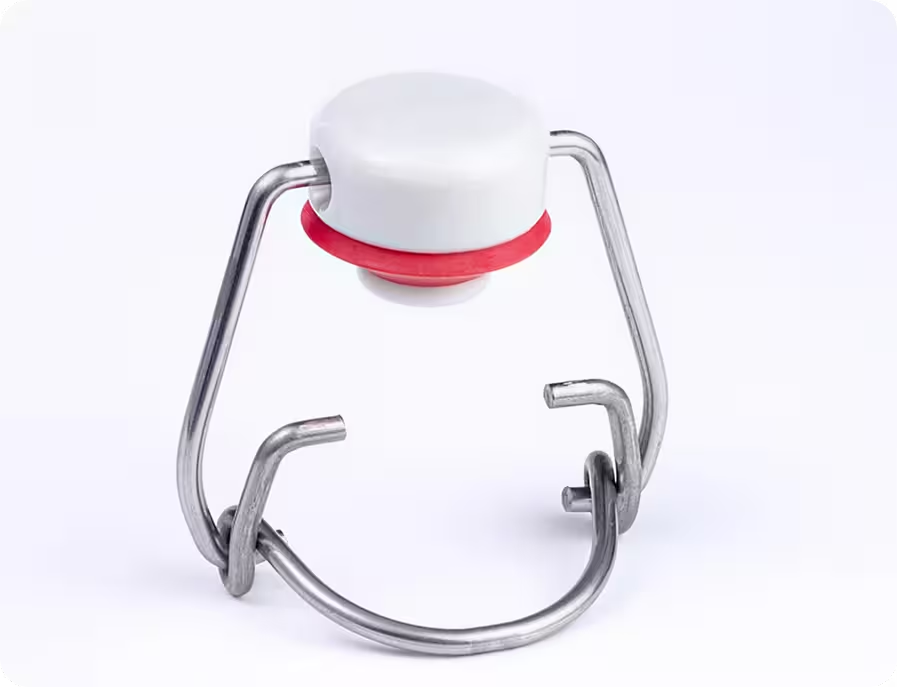
The density of glass does not allow you to predict the sealing of a closure. A mechanical closure works through the combination of a container, a stopper head, a gasket and a wire bail. The quality of their fit must match the conditions of use.
To define this combination, several pieces of information are needed:
- The geometry of the neck and the attachment points,
- Dimensional tolerances,
- The packaged product,
- Any pressure involved,
- Washing or reuse conditions.
Any change to the bottle should therefore lead to checking its compatibility with the closure. A change in weight or shape does not, on its own, tell you whether the mechanism will hold or how the gasket will be compressed.
At Edard, our expertise in mechanical closures allows us to address these parameters at the level of the bottle-stopper pair. The choice of container and closure is best studied together to meet the constraints of your product.
Understanding the density of glass helps you calculate weight and interpret differences between materials. When choosing a bottle, this data point is part of a broader analysis combining design, strength, logistics and closure. Are you developing or updating a container? Let's talk about the closure suited to your bottle and its uses.

Vous souhaitez discuter de votre projet

Continuer la lecture

Understanding the Glass Recycling Process
Verres soufflés, histoire et techniques d'un savoir-faire millénaire
Contact our team